
Over the past year, I’ve worked across B2B sales and marketing, moving between closing deals and supporting them through marketing. Seeing both sides of the equation made certain patterns hard to ignore—especially around how businesses buy and what actually influences decisions.
I spent that period leading sales at Condia, a digital publication, where I was on the front lines pitching clients and learning what it really takes to convince a business to spend. That experience forced me to do the research, understand buyer context, and show up with confidence—even when it didn’t come naturally.
What became clear was that spending less time agonising over errors and more time restoring trust led to better outcomes—sometimes by giving more than was required when things slipped. I also saw firsthand how personal relationships and thoughtful positioning made deals easier to close.
Just as important, I learned when to walk away—especially when client requests became unreasonable or revealed a fundamental misunderstanding of how the business worked. Knowing when not to push turned out to be a skill of its own.
At Startbutton, I moved fully into marketing, working closely with the sales team. I saw how brand equity and affinity softened pitches before they ever happened, and how simple things—customer testimonials and clear, jargon-free explanations—often shortened sales cycles. I also saw where even that still wasn’t enough. Over time, these patterns repeated often enough to be predictable.
Reflecting on the last year, here are seven lessons that have shaped my approach to B2B marketing.
Everything rises and falls on the Product
There is a popular saying in leadership circles: “Everything rises and falls on leadership.” I believe the marketing equivalent is true: Everything rises and falls on the product (or service offering).
What is the company actually offering to its users? What is the “Job to be Done”? Has the company clearly identified who its users are, and does the product actually meet their needs?
You can take two equally skilled marketers and give them different products. The one with the product that has a strong market fit will always outperform the other. The product is the ceiling on your marketing performance.
This means our job isn’t just to push a message. We aren’t just here to get clicks. We are here to bring data back to the product team and business. Brand positioning, customer segmentation…these things matter.
- “Hey, 1,500 people are interested in this specific feature, not the one we are pushing.”
- “Why are we talking to this audience when the data shows a different group cares more?”
For marketers, this leads to an important career realisation. I know this comes from a place of privilege, but you should always strive to work on products that make sense. If you join a company and realise the expectations are unrealistic because the product doesn’t solve a real need—or market conditions (like seasonality) have changed—you are going to be the one blamed for the failure.
Know when to walk away before they stain your white.
Marketing (B2B/B2C) is still all about people
It’s easy to think of B2B as one business entity selling to another, but businesses don’t make decisions—people do. Behind every logo and corporate structure are human beings working toward specific goals.
B2B is still “People to People.” Consequently, success isn’t just about targeting a company; it’s about identifying the specific individuals within that company who matter.
In a case where you can reach the key decision maker, find a Champion. A Champion is someone inside the prospect company who is willing to push your cause and advocate for you when you aren’t in the room. Marketing must be designed to arm these Champions with what they need to sell your solution to their colleagues.
Also, realising you are marketing to people helps you know how to find them. It starts by asking, “Where do they spend their time or what do they pay attention to?”
- Are they scrolling Facebook, YouTube, or LinkedIn?
- Are they at a football game or a conference?
- When do they start planning for the new year, vs when are they closed for the year?
Marketing is simply the act of looking at the vast list of channel options and strategically selecting the best way to meet these humans where they already are, rather than forcing them to come to where you want them to be.
Don’t be surprised that the sales cycle is long
In B2B marketing, the sales cycle can often be very long. This really struck me because I used to think in terms of quick wins, but here, six months is considered normal. Sometimes, you are talking about years.
There are many reasons for this. Large enterprises just take time. They have set guidelines and processes around making decisions that you simply cannot circumvent. There is often nothing you can do to speed that up; you just have to work with it.
This influences how you set expectations and how you refine your target audience. You have to frame your timelines around what is typical for that industry, unless you somehow find a way to hack it.
This is one of the ways in which B2B differs from B2C. In B2C, someone sees an ad, and the next moment, they have bought the product, or the app is on their phone. In B2B, it’s rarely that straightforward. It is a company decision that often requires the buy-in of multiple stakeholders, and you have to account for that wait.
Sales and marketing do different things, but work together
“Selling is only the tip of the marketing iceberg” — Peter Drucker
“The aim of marketing is to know and understand the customer so well that the product or service fits him and sells itself. Ideally, marketing should result in a customer who is ready to buy”
— Peter Drucker
People often try to draw a hard line between sales and marketing, but in B2B, they have to work hand-in-hand.
Context matters here. Generally, marketing is about creating awareness and driving inbound requests. It’s about building enough trust so that when someone sees the brand, they think, “I want to see what they do,” or “I’m interested in this.” Marketing decides where we should be—like saying, “Let’s go to this event” or “Let’s be on this channel.”
Sales is usually focused on closing the leads that are brought in, or doing direct outbound outreach to specific companies and individuals.
But I’ve learned that the line isn’t clear-cut. It’s a two-way street. Sometimes, sales will suggest marketing initiatives or tell us which events we need to attend. Other times, marketing does such a good job talking to someone that the prospect is practically “sold” before they even speak to a sales rep—they just want to get started.
The most important part is the feedback loop. Sales has to come back and tell marketing what they are hearing on the ground—which approaches are working and which channels are actually bringing in the most valuable customers.
Your business model dictates your channels (Channel-Model Fit)
Your business model is how you capture value, and this directly dictates which channels you can afford to use. The logic is simple: you should not spend more to acquire a customer than the value that customer brings you.
This concept, popularised by Brian Balfour as “Channel-Model Fit,” breaks down like this:
Low ARPU (Average Revenue Per User): If you are selling a low-cost product—say, to students or entry-level employees—your revenue per user is low. Therefore, your “Cost of Acquisition” (CAC) must also be low. You cannot afford to wine and dine every customer.
Therefore, the channels you have to rely on are scalable, lower-cost channels like viral social media, SEO, or mass content.
High ARPU (High-Ticket): If you are selling to large enterprises or high-level executives, your revenue per user is typically high. There are fewer of these people, but they are worth much more. Consequently, you can afford a much higher cost to acquire them.
Therefore, it makes sense to invest in intimate events, account-based marketing, or even putting a billboard at a country club or golf course.
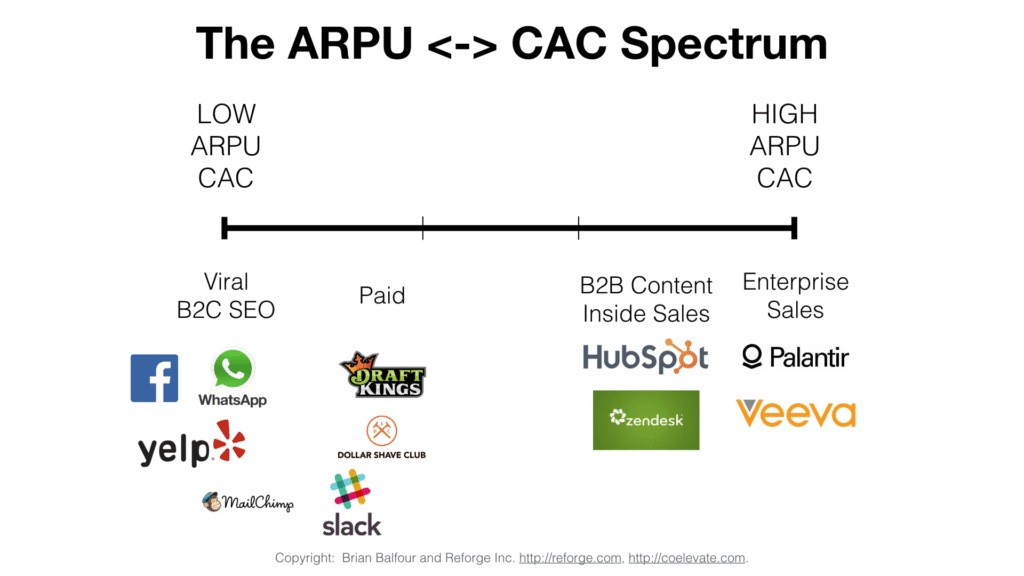
The biggest mistake is a mismatch. It makes no financial sense to host an intimate, expensive dinner event for a low-cost product. Conversely, for a high-ticket B2B solution, just posting on social media often isn’t enough. You have to look at the math, look at where the decision-makers actually are, and ensure the channel fits the price point.
The Funnel exists for a reason
Awareness → Acqusition → Activation → Retention → Advocacy
There is a reason why marketing funnels became wildly popular: they provide a measurable structure to an otherwise complex customer journey. When you understand the funnel, you understand where you can influence the customer.
Awareness
The first step in this journey is Awareness. Do people simply know you exist?
It is very easy to want to jump straight to the transaction—to skip right to Revenue. There is a great meme about this (shout out to Elena Verna) that highlights the absurdity of trying to harvest before you plant.
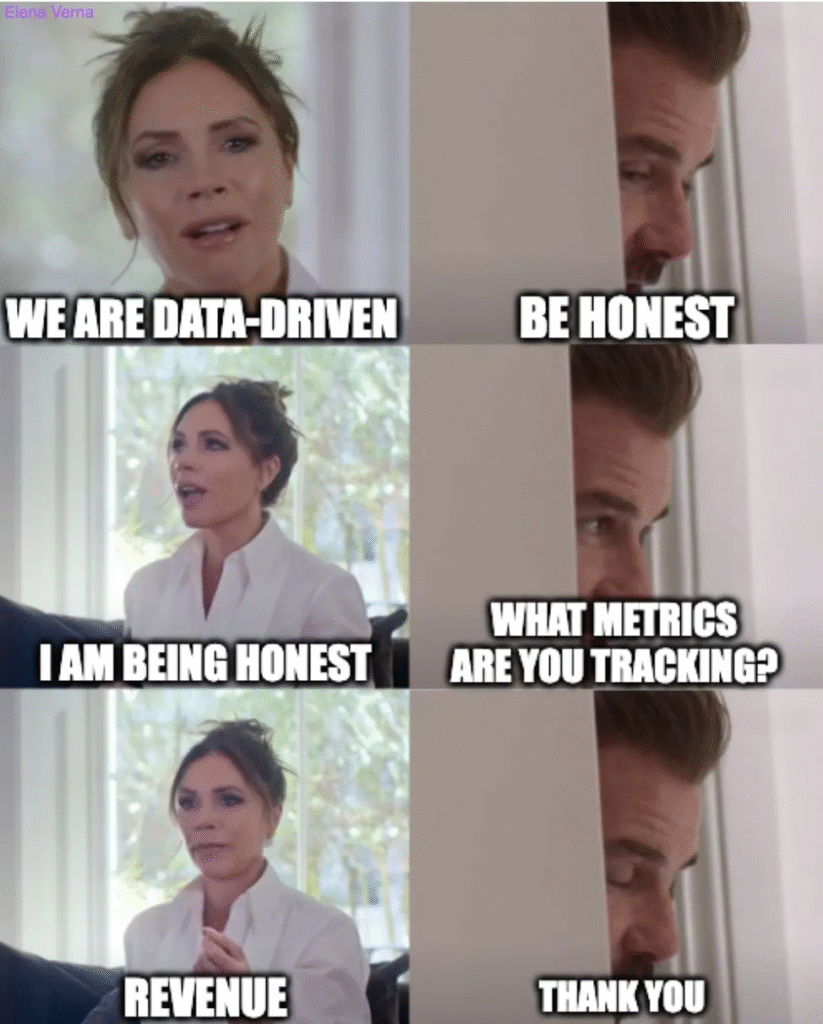
If you skip awareness, two things happen:
- Sales struggles: Your sales team has a much harder time closing deals because the prospect has “never heard of you.”
- Costs skyrocket: Acquisition becomes incredibly expensive because you have no “air cover.”
Acquisition
I already addressed this in the previous point on Channel-model fit.
Activation
Even when you do acquire them, you have to distinguish between Acquisition and Activation.
- Acquisition: You get 100 people to sign up for your platform.
- Activation: They actually take the action where they experience value from the product.
That is where the real work begins. You might have a great “public” number of users to show off, but internally, if they aren’t activating—if they aren’t doing the thing the product was built for—you haven’t actually succeeded.
Please note that activation looks different for every business:
- For a Bank: It’s not opening an account; it’s making a deposit or doing a certain number of transactions within a set period.
- For Miro: It’s not just creating a board. Since it’s a collaboration platform, true activation is when a user shares that board with someone else.
- For Slack/Figma: It’s sending a message or inviting a collaborator.
You have to define the action that proves the user is getting value.
Once a user is active and generating revenue, the focus shifts to Retention.
Retention
Retention is a tricky subject, and I’ve learned that when customers churn, it’s usually due to one of three specific failures.
1. Retention problems are often just acquisition problems in disguise. If you acquire the wrong users—people who were never a good fit for your solution—no amount of onboarding will keep them. You have to look at the quality of your acquisition channels. Are you bringing in people who actually have the problem you solve?
2. Customers change. The market changes. What satisfied a user six months ago might not satisfy them today. The whole idea behind product evolution is that you must keep up with these changes. If your product stands still while the customer’s needs evolve, you are no longer delivering value.
3. Reliability issues. Even the best of products and services have bad days, but how often the bad days occur could be the difference between a forgiving user and a churned one.
- If my bank app is down and I can’t transfer money, I panic.
- If I can’t order a meal from my food delivery app when I’m hungry, I get frustrated.
In that moment of failure, the user asks: “Why am I using this?” This forces them to consider an alternative. If a competitor works when you don’t, the user moves.
Sometimes users leave because of a specific bug or missing feature. If you fix that issue but never tell them, they won’t come back. You have to close the loop: “We fixed the thing that annoyed you.” And for those who stick around through the ups and downs? You must keep them informed (think: lifecycle marketing) and reward that loyalty.
But how do you appreciate them? It’s not always about throwing generic discounts at them. It starts with listening. You have to understand what actually matters to them.
- Recognition: Sometimes, highlighting a user’s success story or giving them a “badge” of honour in the community matters more than a 5% coupon.
- Special Offers: If you give an offer, make sure it’s relevant to their usage.
- Access: Giving loyal users early access to beta features shows you value their opinion.
What’s important here is that the reward must match the user’s needs. If you listen to them, you will know exactly what makes them feel special.
Advocacy
One of the best ways to keep growing is through referrals because your existing customers are your greatest promoters. For these to happen, these three elements must be present.
- Great Product. This part comes naturally if you have a great product. If you are truly meeting their needs and solving a painful problem, they won’t be able to stop raving about you. Once again, a great product is the foundation; without it, you are wasting your time. You cannot incentivise someone to recommend a product they hate.
- Ask. You have to actively ask. From your messaging to your product interface, you need to remind them to bring others along. If you don’t ask, you won’t receive.
- Incentives. Relying solely on organic word-of-mouth isn’t enough. You have to incentivise them. You would be surprised how many people are willing to refer others but just need a small “nudge”—a gift, a discount, or a reward—to actually take action. For example, I’ve seen great success with offering commissions on transactions for a set period. If a company make an offer for its users to “Refer a friend and get a percentage of their transaction fees for 2 years. This encourages them to refer quality people (because they only get paid if the referred person actually transacts). It turns your customer base into an endless pipeline of new leads.
The law of shitty click-through rate and why we have to keep on experimenting
Shout-out to Andrew Chen for popularising this concept. It is one of those things that seems obvious in hindsight, but it explains everything: The Law of Shitty Click-Through Rates.
The law states that over time, all marketing strategies eventually result in shitty click-through rates. A channel works until it doesn’t.
Think about the history of advertising—from billboards to radio to TV to banner ads to Facebook. When a channel is new, it is novel. People pay attention, and the early adopters get incredible ROI. But inevitably, everyone else rushes in. The channel becomes saturated, users get tired of feeling “sold to,” and effectiveness plummets.
The lesson here is that nothing keeps working forever. Once something becomes obvious, everyone crowds into it, and the value diminishes.
Therefore, you have to constantly ask yourself: “How can I find the next channel that hasn’t been ruined yet?”
- Why not try that new platform (like TikTok was a few years ago)?
- If everyone is putting billboards in the city centre, why not try a location where my audience hangs out that no one else is looking at?
You have to look where others aren’t looking. Without experimenting with unproven methods, you can’t discover new platforms or get that ridiculous ROI that comes from being first.
You have to keep asking: “What is something new I can do today that is different?”
Resources that I found helpful
Over the past year, I spent time reading deeply and comparing notes with peers across companies to get clearer on what’s actually working and what’s not. Here are some of the best resources (mostly blogs, newsletters and a podcast) on marketing I found out there.
- Uncensored CMO: Straight-talk guidance on building and running modern marketing teams without fluff.
- Growth Unhinged: Sharp, contrarian breakdowns of what actually drives growth beyond popular marketing dogma.
- Marketing Ideas: Highly actionable, day-to-day advice you can apply immediately to marketing campaigns and funnels.
- Why we buy: An exploration of buyer psychology that explains how emotion and behaviour influence purchasing decisions.
- MKT1 Newsletter: Deep, operator-level analysis on how the best B2B companies build marketing, growth, and go-to-market systems.
- Growth.Design: Insight on how product design and user experience directly impact growth and retention.
- Growth with Sean Ellis: Foundational thinking on growth marketing, experimentation, and finding product-market fit.
- Brian Balfour: Rigorous thinking on growth loops, experimentation, and building sustainable growth systems at scale.
- Growth Case Studies: Real-world breakdowns of how companies achieved growth, with lessons you can replicate.
- Alec Sultanic: Practical frameworks for outbound, demand generation, and scaling B2B revenue.
- Elena’s Growth Scoop: Operator-level insights on growth strategy, experimentation, and monetisation in product-led companies by Head of Growth at Lovable.
- HyperGrowth Partners: Hands-on growth consulting and frameworks focused on scaling B2B and product-led SaaS companies.
The end.
Thanks for reading this far. I work on go-to-market and growth for companies in emerging markets, across media and SaaS. I enjoy talking with people, thinking about marketing and growth—what’s working, what isn’t, and what we’re all learning. If any of this resonated, feel free to reach out. hello[@] danieltadeyemi.com or @danieltadeyemi on most social media platforms.
Leave a Reply